
There’s an old adage attributed to Lao Tzu, “Give a man a fish, and you feed him for a day. Teach a man to fish, and you feed him for a lifetime.” Men fish either to earn a living or as a hobby.
For the hobbyists it’s a quiet sojourn with nature in secluded spots, holding a fishing rod with the line immersed in the still, hypnotic waters, waiting for a bobbing of the floater indicating a fish biting. The wait induces a Zen like meditative state, described as a condition of effortless awareness—calm, alert, and fully present—without chasing thoughts or suppressing them.
I have many memories of fishing which I want to share but forgive me as I drift into memories associated with those experiences.
Ice fishing
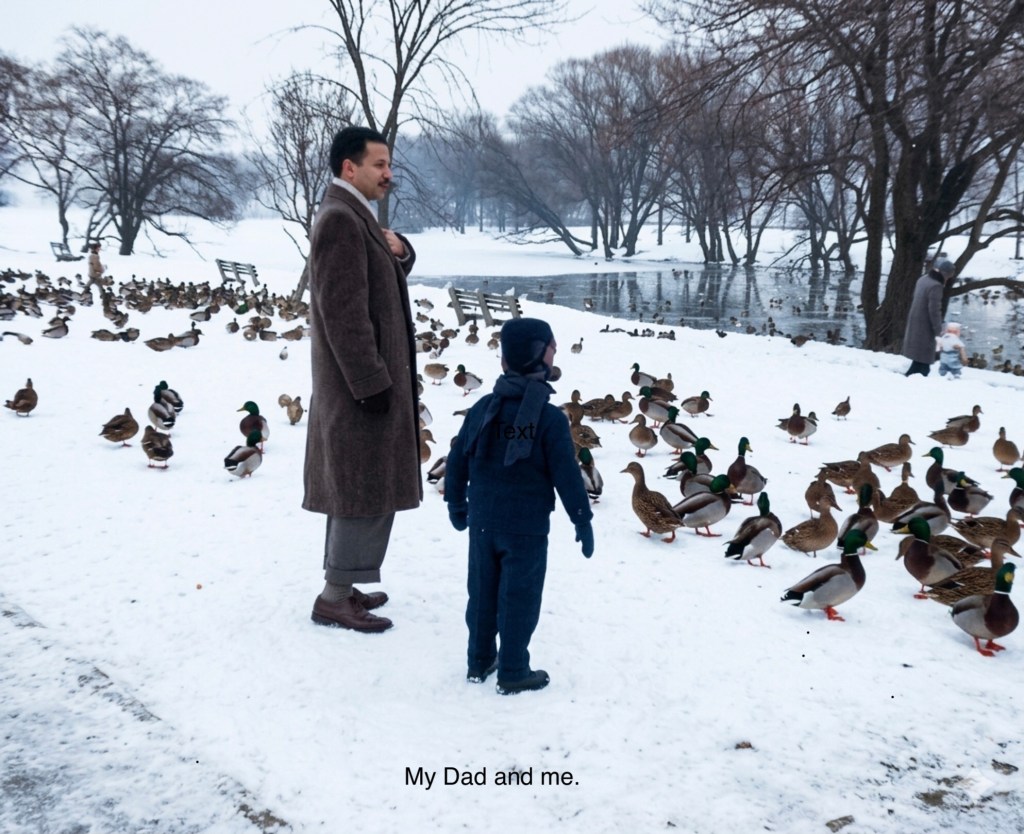
My earliest memories of fishing was when I was 4 years old and my family had relocated from India to a small town in rural Michigan, USA called Hillsdale. The state of Michigan can be easily identified on the map of USA because it resembles a mitten and it’s just across the Great Lakes to Canada, with frigid winters.
My father was a visiting Professor of Sociology in the local Hillsdale College and we lived in a rented house just across the college campus, ‘231 Hillsdale Street’.
Our next door neighbours were the Dotys an elderly couple with an adult son Philip and young daughters, Jane and Joanne, they were all adopted. They were the typical American mid western family with a small patch of land behind their house which Mr. Doty cultivated. They also had a stable with horses and they were into outdoor activities like fishing.
Near the town there is the ‘Baw Beese’ Lake, a large freshwater lake named after Baw Beese, a Chieftain of the Potawatomi Native American tribe, who lived in the area in the early 1800s. The tribe camped, hunted, and fished around the lake but in 1840 were forcibly relocated during Native American removal.
In the summer the lake was popular for swimming and during the winter it froze over with a solid sheet of ice, ideal for winter sports like ice skating and of course ice fishing.
My father was adventurous, and liked to experiment. He also wanted to expose me to new experiences. One fine subzero winter’s day he said “let’s go ice fishing!”, though he himself had no prior experience of ice fishing. My mother being the cautious one and had a pessimistic outlook admonished him about subjecting me to the possible prevailing perils. However that didn’t deter my Dad, he borrowed the necessary fishing gear from our neighbours and purchased live bait from a sports shop.
My mother got me suitable dressed for prolonged exposure to subzero Artic temperatures. There were the multiple layers, first were the basic undergarments over them were warm thermal undergarments and then regular warm clothes and finally snow pants, coat, mittens, snow boots over warm socks and shoes. After my mother had got all those layers on, I told her I had to pee! So my mother had to remove all those layers so I could do ‘susu’ and then patiently repeat the process.

My Dad and I drove to the lake on our Rambler station wagon and after parking on the edge of the frozen waters, we proceeded to a suitable spot on the frozen lake. The areas with thin ice were marked with a warning sign ‘Caution! Thin ice!’ and the areas where it was safe to walk were marked as safe. After choosing a suitable spot somewhere in the middle of the lake, my father drilled a hole using an ice auger. It cut a nice, neat circular hole in the ice around 6” in size. Then we placed two foldable stools around the hole, he baited the line, cast it into the waters and then we sat and waited for the floater to bob!
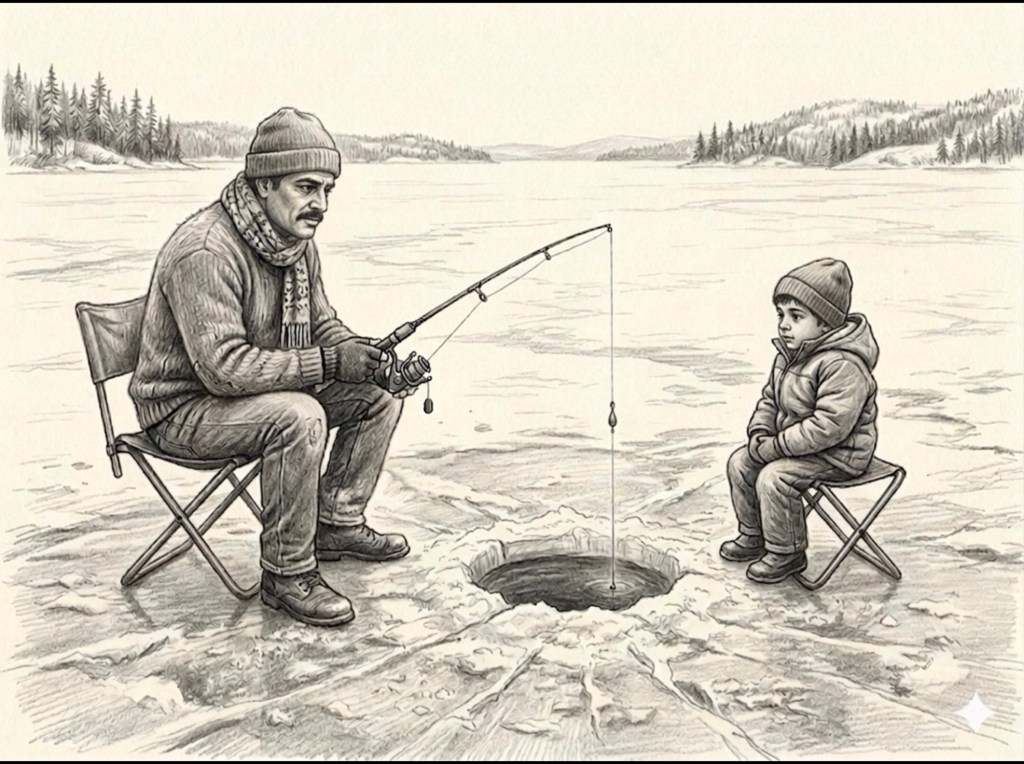
During the winter perch, bluegill, and pike are the more likely to bite under the ice. But they decided to give our bait a wide berth, this may be due to the fact that most fish are cold blooded or ectothermic, in cold water their metabolism slows down so food requirement also decreases. After maybe an hour of exposure to the elements we decided to call it quits and return to home and warmth of a hearth.
Blast fishing
Back in India summers meant visits to my father’s ancestral home in Tanakpur now in the state of Uttarakhand, then part of the undivided Uttar Pradesh. It’s nestled just before the foothills of the Himalayas, an area called the ‘terrai’, the weather was pleasant as compared to the furnace like heat of the plains.
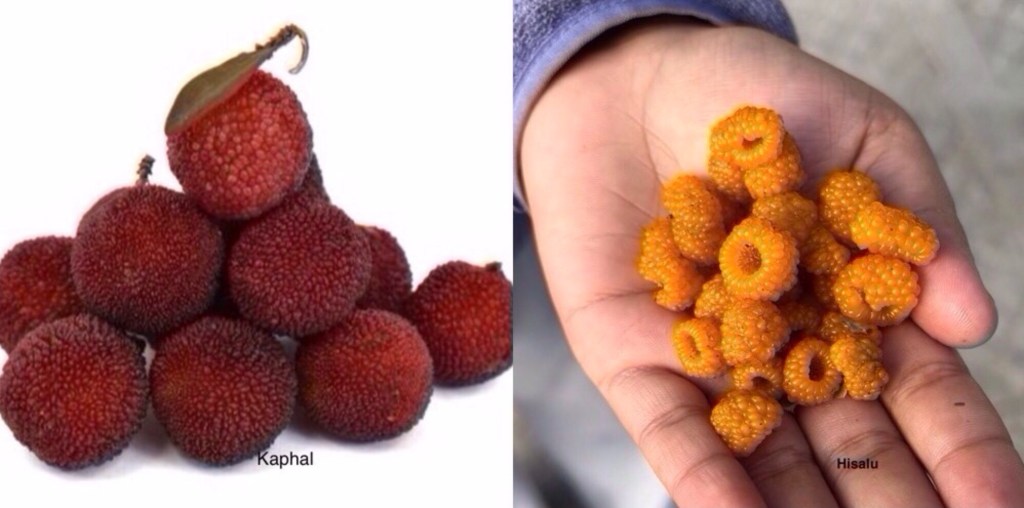
The natural beauty is stunning, a short drive and the mountains would commence, you would see pine trees with interspersed fruit trees of Kaphal (Myrica esculenta), a small, dark purple or black berry and Hisalu (Rubus ellipticus), also known as the Himalayan raspberry in English. These berries are unique to the Himalayan region and the state fruit of Uttarakhand and extremely tasty plucked directly from the tree.
There were mountain streams flowing with icy pristine waters, emptying into small ponds which were teeming with fish.
My father’s younger brother Richard Wilkinson or better known as Dicky Sahab’ was a gentleman farmer on our ancestral Sunny farms, Gyankheda. He was a bachelor and extremely fond of children. When we visited he would lavish us with gifts. He would buy us stacks of comics and books so we would be entertained.
My grandfather, Richard Wilkinson senior, better known as ‘Sunny Sahab’ or ‘Padre Sahab’, also lived on the farm was and was a retired priest of the Methodist Church. My Dicky Uncle used to refer to the church, tongue in cheek as the ‘Mahadusth Church’ (महादुष्ट) or wicked church, most probably because of the quarrelsome nature of the congregation.
My grandfather was in his 70s and hard of hearing so communication with him was limited. I would stand behind him and call him ‘Dada’, in a low voice and progressively raise the pitch of my voice. When my mother asked me what I was doing, I told her I’m experimenting and determining what pitch is audible to Dada. He spent his time repairing a small church organ, a never ending task which would keep him occupied for the remainder of his life.
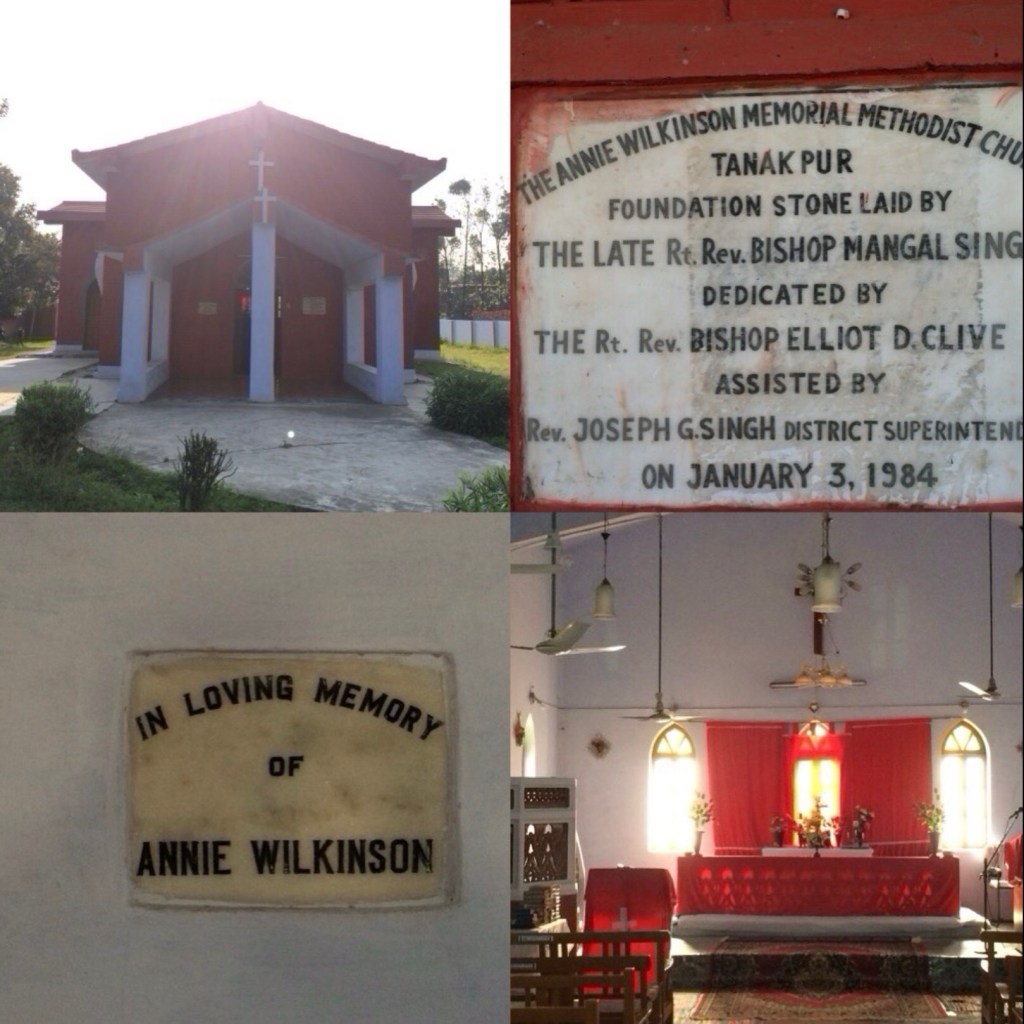
He had donated a piece of land on the main road for a Church in the memory of his wife, my grandmother who had passed away when my father was a young boy.
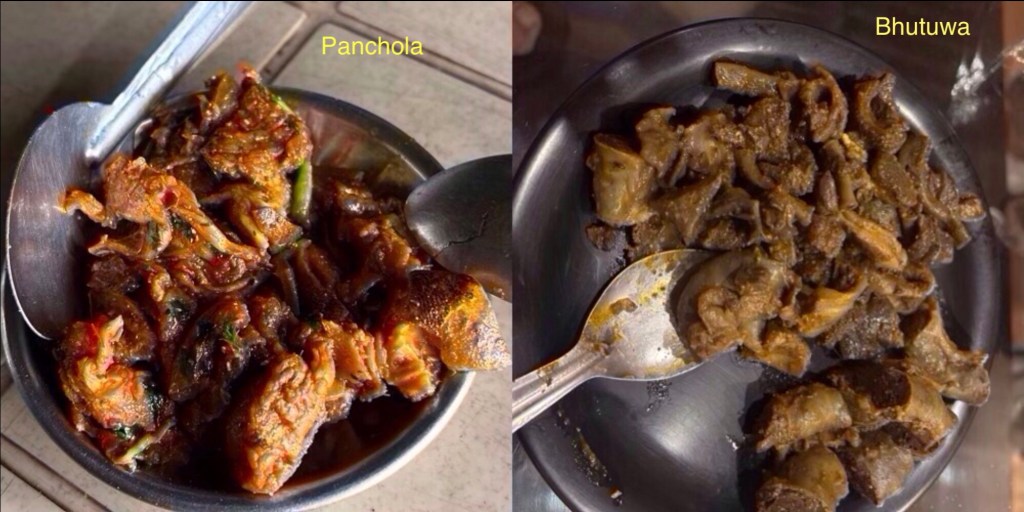
There was an old family retainer called Prem Singh who had been with the family since the time my father was a child and he was the only one I have heard referring to my father as ‘Baba’, a term of endearment for a small boy. We learnt phrases in the Pahadi language from him like “Khanan nikki cho” which meant the food is good. He would cook us some Pahadi specialties like ‘bhutuwa’, ‘kachpoli’ and ‘panchola’.
In Kumaon these are traditional non-vegetarian preparations, especially made during feasts or after a goat sacrifice. Bhutuwa is a rustic dish made from goat intestines (offal). The intestines were thoroughly cleaned, boiled first to remove odor and impurities, then finely chopped and cooked by ‘bhunna’ (slow sautéing) with mustard oil, onions, garlic, ginger, turmeric, chili, coriander. It’s was cooked till dry and slightly crisp. Kachpoli is a traditional stuffed flatbread, somewhat like a rustic paratha, stuffed with minced or finely chopped, goat meat, liver and fat. This meat is cooked with spices and made into a dry filling which is stuffed into the wheat dough and cooked on a tava or flat pan with ghee or clarified butter. Panchola is usually prepared from finely chopped goat meat, often mixed with fat, liver, spices, chilies, coriander, lemon, and sometimes lightly smoked or barely cooked pieces.
These dishes reflects the resourcefulness of the hill communities in use of the entire animal to make a high-energy food suited for the mountainous life. Goat meat has historically been an important celebratory food in Kumaoni culture.
My uncle had a friend who had retired from the navy, ‘Gabbar Singh’, this was much before the movie Sholay featuring a villain with the same name and giving it sinister connotation.
Dicky Uncle constantly used to pull his leg, he used to tell us in a mock serious tone, “Children remember his name is Gabbar Singh and not Gadbad Singh (chaos). Then once when I called him Gabbar Singh, my Uncle in mock anger said ” How many times I have to tell you his name is Gobar Singh (cow dung)!”. Gabbar took it all sportingly unlike the film Gabbar he was very good natured.
My uncle took us for a picnic up in the mountains along with Gabbar Singh and other friends on his jeep. We stopped near a pond formed in a natural depression in a rock, fed by a stream. The pond was teeming with fish and there I was exposed to ‘blast fishing’. Gabbar Singh with his military contacts obtained explosives which were wrapped in a waterproof plastic, a fuse lit and it was thrown into the pond. The blast created a mini tsunami and in its wake came stunned and dead fish, floating on the surface of the water. They were quickly scooped up by Gabbar and other helpers, who had jumped into the water after the explosion. I can still picture Gabbar Singh chest deep in the water with a cigarette in his lips, gathering fish and tossing them to the bank, interspersed between the fish were floating unlit Panama cigarettes, which had escaped from the packet in his shirt pocket.
This form of fishing is now illegal and banned, it causes ecological damage and is not a sustainable form of fishing, it’s also very dangerous because of the use of explosives.
The fish was cooked on site by the helpers on a bonfire and we had a sumptuous picnic lunch. The catch was so bountiful that we could carry back fish for consumption at a home.
Fly fishing and Jugaad fishing
Sattal Christian Ashram in Sattal, Nainital district, Uttarakhand was founded in 1930 by the missionary E. Stanley Jones as a place for quiet meditation and reflection. It covers an area of around 400 acres centred around a lake. Lakes in this region were created by the collision of the tectonic plates, creating mountains and deep valleys. Lakes formed at the depth of these valleys are fed by underground springs and not by draining rivers thus were devoid of silting hence deep. The surrounding mountains are densely forested with oak and pine trees which prevented rain erosion and flow of mud into the lake. There is no sewage or industrial discharge into the lake in those days. The depth of the Sattal lake though no official records exists is estimated to be between 65-120 feet.
Sattal literally means 7 lakes and consists 7 interconnected lakes. The other lakes in the region are similarly named due to some characteristic feature, most famous of them is Nainital which literally means ‘lake of the eye’, because it’s an oval deep set lake, resembling an eye. Legend has it that the lake represents the eye of Goddess Sati.
Thanks to the healthy ecosystem there is an abundant, varied and thriving fish population, like the red finned and yellow finned Mahseer, a prized fish. Rohu, Mrigal, Catla and a snowtrout-like fish. Recently scientists have identified a new mahseer species named Tor sattalensis, named after the Sattal lake region. All evidence of the unique fish biodiversity of these waters.
Around the lake the Ashram maintains cottages for rent, nestled in the dense forests and near the shores of the lake. One summer in the early 70s my father booked a cottage for the family. We had driven down to Tanakpur from Nagpur in our old Fiat and after spending some time in Tanakpur we drove to Sattal. The car could not be driven upto the cottage and had to be parked near the main Ashram building and we had to walk down to the cottage our luggage being carried by porters.
The amenities of the cottages were basic, no electricity, we used kerosene lanterns for illumination in the nights. We had brought along a kerosene stove for cooking and a local boy named Bhupchand was recruited for the cooking. All the supplies had to be bought from the nearest town, Bhimtal.
My two elder sisters and I spent most of the day near the lake. A young German couple, their baby and a younger male, who was the brother of the husband, had rented a nearby cottage. There was a rowing boat tied to a small pier on the lake and was for common use, the older German would use it for ‘fly fishing’.
Fly fishing is a method of fishing where artificial flies (very light lures made of feathers, fur, or synthetic fibers) are used to imitate insects that fish feed on. It suits clear, cold, oxygen-rich water, which is why Himalayan waters are ideal. The older German would row to the deeper waters then using the fishing rod and the line like a whip, skim the weighted fly over the surface of the water, mimicking an insect skimming on the surface of the water. Fish believing it’s an insect would bite only to get hooked, they would splash on the surface and had to gradually be reeled in without breaking the line. The fish would still be alive, flapping around and to hasten its demise he would hold it by its tail, lift it and slam its head to the floor of the boat.
The younger male would spend his time snorkeling near the shore. We would ask asked him the what he saw. He would dived down and exclaimed, “Mama Mia! I saw this big fish!” Indicating the size by holding his palms a foot apart.
In the waters near the shore we could see schools of tiny fish swimming in the clear shallow waters nibbling on our immersed feet.
We devised a way of catching these small fish. Two of us would stand in the water holding the corners of a fine dupatta cloth, immersed in the water, while the third would dangle a bit of roti from a string into the water luring the fish over the cloth. When a large group was gathered then the cloth was lifted out of the water, netting a large catch of bite sized fish.
My father got enthused about fishing seeing all the activity around him and the reported size of the fish in the lake. The question was how to go about it?
‘Jugaad’ a uniquely Indian term means a clever, improvised, low-cost solution—often created by using limited resources, shortcuts, or unconventional methods to get a job done.
We did not possess the hi tech fibre glass flexible fishing rods and paraphernalia the Germans had, so we had to improvise.
We made a sortie to the nearby town of Bhimtal where we purchased fishing hooks and fishing line. A suitable branch from a tree was cut using a Swiss pen knife, the smaller branches were removed and paper clips were tied at 3” intervals with string. Through these paper clips the fishing line was threaded and for a reel an eaten ‘bhutta’ or a corncob was used, the kernel had been eaten. The excess line was wrapped around it. The stick was still green and hence was flexible, bamboo would have been perfect but it did not grow in these Alpine climes. A hook was tied to the end of the line and was weighted by tying a small pebble just above, the floater was a small twig tied to the line and for bait we used the tiny fish which we had netted in abundance.
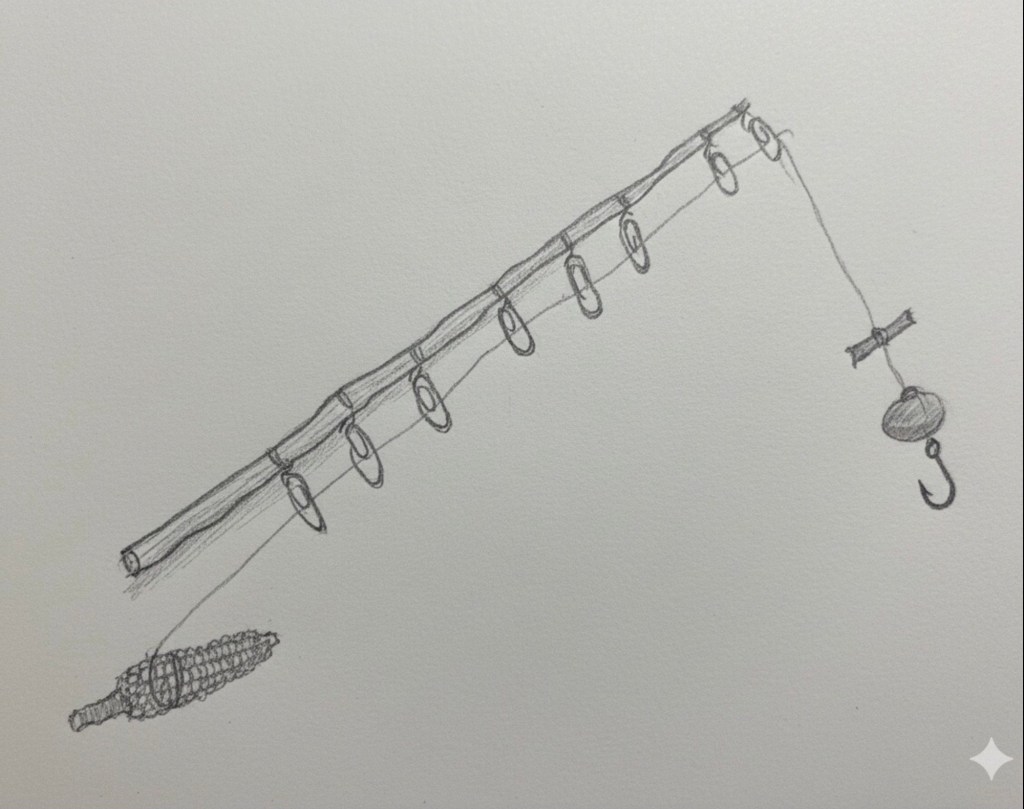
These were the basic components of an unwieldy fishing rig, the rod with the attached line, the baited hook and a sinker near it giving weight so it will descend to a depth. The floater tied some length away from the hook allowed the line to be suspended from the surface of the water and bobbing of the floater would signal that the fish had taken the bait.
Thus began our daily bouts of fishing, we would find a suitable place on the shore, my father would cast the line some distance into the water by holding the line, swinging it around in a circular fashion like a lasso and casting it into the water, the fishing rod was too unwieldy for casting. And then we waited and waited and waited! Maybe after an hour of waiting there was some bobbing on the floater, my father immediately started to pull in the line and I would wind it on the corncob. The fishing rod was more symbolic rather than functional. There was plenty of splashing on the surface as the fish resisted and then suddenly the water became calm. We reeled in the line to find an empty hook! Because of the struggle by the fish, the hook had cut through the mouth and the fish was liberated.
Since the Germans seemed to have greater luck and experience in catching fish my father consulted them. After discussing his technique they suggested not to reel in the fish immediately but to allow it to splash around, play with it and tire it out, then gradually reel it in.
Our next catch we managed to reel in and it was a large fish, I don’t know what variety of fish it was but it was cooked by Bhupchand eaten and relished.
As a footnote we were so impressed with the services of Bhupchand we tried to persuade him to return with us to Nagpur and take permanent employment with us. He said he would consider and it remained at that!
SS, Fishing in Paunar and Vinoba Bhave
I have a school friend let’s call him SS, a good friend albeit being transactional in his approach, for example if he wanted to borrow a pencil he would strike up a barter, in exchange of a pencil he would grant the lender the ‘privilege’ of playing football as part of his team during the recess. He marched to the beat of a different drummer!
His family were from Balaghat in Madhya Pradesh, near Kanha National Park and his grandfather was an ardent hunter of his times, when hunting was legal. The drawing room of his house had two full tiger skins shot by his grandfather nailed spread eagle on facing walls, with the tails to the roof and the heads supported by small tables so facing each other with a taxidermist created open mouth, bared teeth snarls. As you entered the room it looked like two tigers snarling at each other. He loved showing us his grandfather’s collection of hunting rifles, there was a double barrel 12 bore shotgun and a rifle with which his grandfather had shot the tigers. Imagine the thrill of a 14 year old handling actual firearms.
During the 2 month summer vacation our group of friends looked to SS for ideas on how to spend our time and he had plenty, “Let’s go hunting!” he said.
In those days anti poaching laws were lax, a lot of people would go hunting in the forests surrounding Nagpur for the herbivores, some of them were considered pest as they would graze on the crops. But the carnivores or big cats were taboo. There are stories of an influential person of the city returning from a hunting trip in his open Jeep with the carcass of a deer strapped onto the bonnet. His attire fitted into the lore of the great Shikari of yore, sporting a luxuriant handle bar mustache, solar topee (pith helmet), aviator shades, khaki camouflaged clothes, behind the wheel of a jeep.
For hunting there were two groups coordinating with each other, the spotters and the shooters. The spotters preferably seated on the roof of the vehicle would scan the jungle surrounding the road with a strong spotlight and the shooters would be sitting below with their gun poking out of the window. Suddenly in the darkness two fluorescent eyes or eyeshine would be visible, glowing in the darkness. In nocturnal animals there is a reflective layer behind the retina called the tapetum lucidum. Light enters the eyes and gets reflected back giving the photoreceptors cells in the retina a second chance to detect light, improving the night vision.
It would be a herbivore deer either a sambar, neelgai, barasingha or a wild boar. The animal would freeze in the light giving the shooters a perfect shot, then there would be the gun shot and the deer would be felled. Then everybody would lend a hand hauling the kill and loading it on the vehicle. It was then taken to someone’s home and help of a local butcher was taken to divide it into shares for the team. In case of a male animal the testis were sought after by the locals in belief that they enhanced potency.
SS had a sealed beam spotlight again handed down from his grandfather, which is used for hunting, it gives a bright beam of light. In a sealed beam spotlight the bulb, reflector and lens are built into one permanently sealed unit. But it requires a car battery to power, we needed a vehicle to transport the searchlight along with a car battery and the rifle. The ideal would have been a jeep but that was way out of our league. SS tried to strike up a bargain with an autorickshaw wala to transport us in exchange for a share of the venison! This was turned down by the autorickshaw wala, because he did not consume venison, so a bargain was struck on pure cash.
We were barely in our teens but SS looked mature and was already closing to 6 feet in height. I don’t know about SS’s parents but my parents put their combined feet down heavily against this dangerous persuit. We were going to do an illegal activity and carry firearms, an accident could happen or we could get arrested.
So SS came up with the idea of going fishing, he had a group of Anglo Indian friends who were school drop outs and spent most of their time fishing. They were his consultants and they suggested Paunar river which is around 80 kms from Nagpur. Paunar river is a good fishing spot with abundant fish, less crowded and secluded.
Paunar is also famous for the Paramdham Ashram of Vinoba Bhave.
Vinoba Bhave was a disciple of Mahatma Gandhi, a social reformer and a spiritual leader, he was most famous for the ‘Bhoodan’ movement or voluntary donation of land. He walked across India (padyatra), halting at villages and requesting those with surplus land to donate it to the landless poor.
I would have a future encounter with Vinoba Bhave in 1976 when my uncle from USA, visited us and brought a group of American tourists who he was giving the ‘India Experience’. An audience with Vinoba Bhave was on their itinerary. At that time Vinobaji was 81 years old and hard of hearing, he consented to an audience but with a caveat, “No political questions would be entertained!”
Those were turbulent political times as the then Prime Minister of India, Indira had declared Emergency in 1975, suspending civil liberties. Vinobaji was called a ‘Sarkari Sant’ by his critics, literally meaning a Government Saint, but a term used to describe a spiritual or moral person who is seen to be too close to the Government. This was because he did not criticise the Emergency but described it as “Anushasan Parva” or a period of discipline. His supporters argued that he was not politically motivated but focused on moral and social reform.
I tagged along with the tourists to the Paunar Ashram for the audience. The entire ambience of the Ashram was spartan and we were led to a hall where there was a raised cement platform at one end. Vinobaji sat cross legged on a mattress in front of him was a writing desk with short legs on which he was busy writing. He looked up and acknowledged our presence with a smile. He was frail and his face and features were completely covered with a luxuriant beard and moustache. He wore an olive green hood-like cap which had a short stitched brim in the front like a small visor and long side flaps covering the ears and neck, perfectly framing his face, he had a white cloth draped like a shawl over his torso and wore a dhoti.
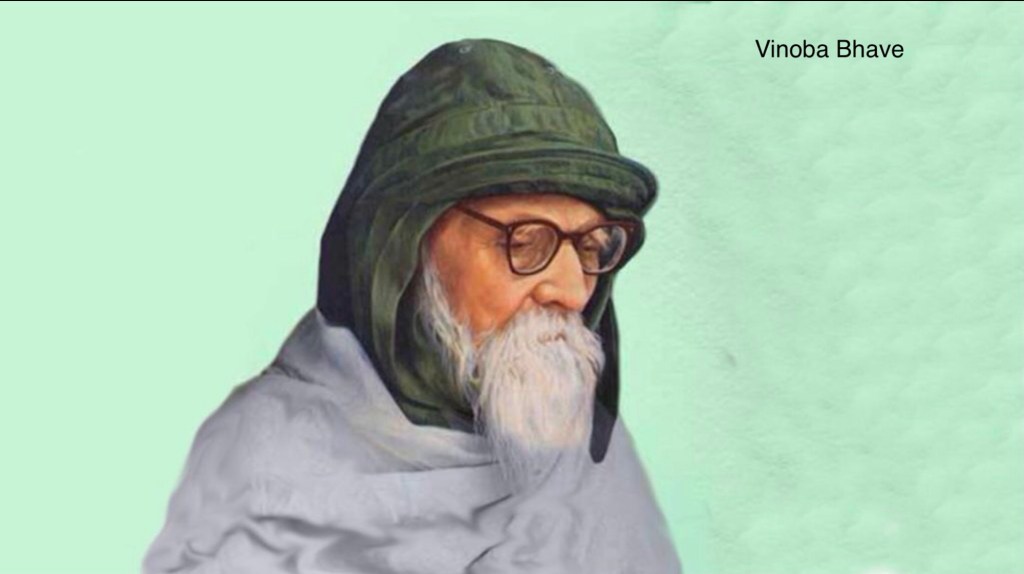
His frail physique was due his belief that food should sustain life but not stimulate indulgence and he often said “Food should be eaten as medicine to the body, not for pleasure.”
His secretary sat next to him and spoke fluent English. He announced that because Vinobaji was hard of hearing, all questions had to be written on slips of paper which would be read out aloud and then whispered to Vinobaji in Marathi, the answers would be read out as dictated by Vinobaji.
I recollect one question clearly, “What advice would you like us to convey to our President?” This question transcended Vinobaji hearing and language barriers and without waiting for the intermediary, he answered loudly, “Tell him to become vegetarian!” There was laughter in the room, the President of the USA at that time was Jimmy Carter who in his earlier avatar had been a peanut farmer in Georgia. “He’s already vegetarian” someone retorted, “He only eats peanuts,” which was followed by another round of laughter.
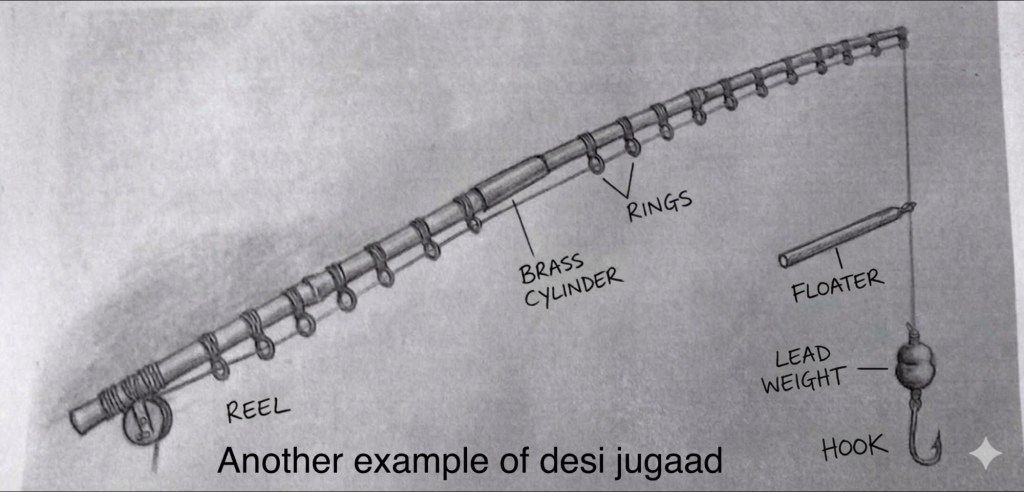
Once Paunar was decided, the logistics were worked out, we would travel to Paunar by a local train, these travel very slowly and stop at almost every station. A family friend after learning about my enthusiasm for fishing gifted me with his old fishing rod which he did not use. It was made out of a bamboo stick which was straighten by heating and cut into two halves for convenience of carrying. The two halves could be joined together by a small brass cylinder fitted at the end of one half allowing the other half to be pushed into it, a male-female joint. The brass cylinder was originally the cartridge casing of a bullet which had been bought as brass scrap from the Ordinance factory in Nagpur, the closed end was sawed off creating a tapered cylinder. Rings to pass the line were lashed to the stick at intervals with twine and a reel was lashed to the end. For the floater the stem of a peacock feather was tied to the line, a small piece of lead which was hammered and flattened, then wrapped around the line as weight and of course the hook at the end of the line.
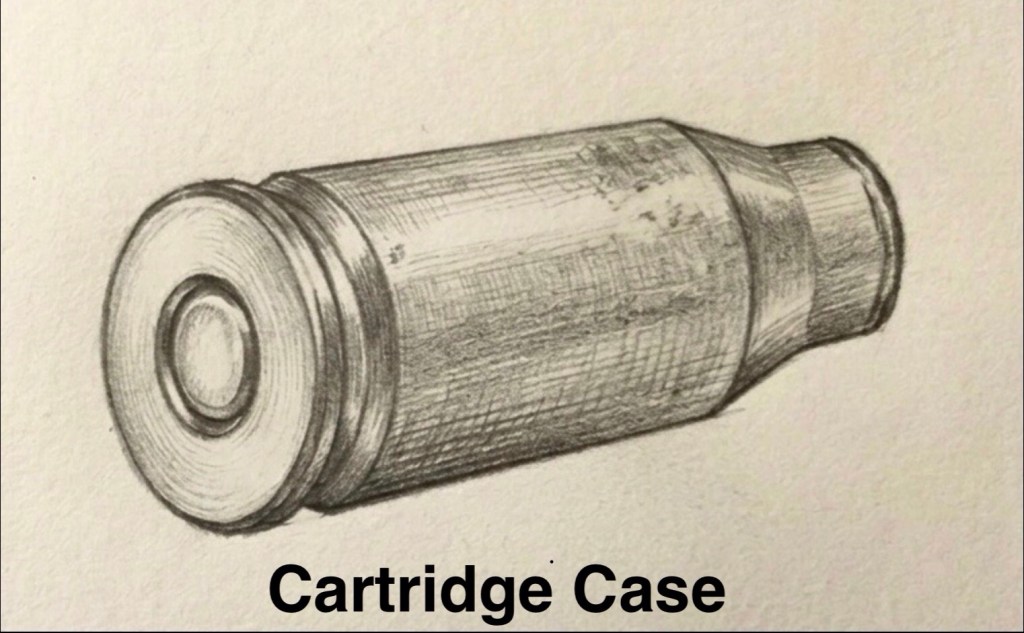
For bait one of SS’s Anglo Indian friend woke up at the crack of dawn, in keeping with the saying “The early bird catches the worm”, dug up the moist soil at a suitable site, this unearthed earthworms which were collected and placed in a can.
“Earthworms are a farmer’s friend “ is a classic statement and very accurate in agriculture. They are natural tillers of the soil, they consume organic matter and excrete nutrient rich waste and actively promote healthy soil microbes. Using earthworms as fishing bait is one of the oldest and most effective techniques—simple, reliable, and still widely used. They’re the natural prey for fish, the wiggling attracts the fish and the strong odour makes them detectable to the fish even in muddy waters. They can be either threaded on the hook or hooked at one point allowing them to wiggle and attract the fish. Threading may be better as then the fish have to swallow the entire hook along with the worm, whereas hooked in one place the fish nibbles only at the suspended portion of the worm.
We boarded the train to Paunar from Nagpur station, early one morning, the train crosses the Paunar river. Paunar has no railway station but passenger trains go slowly, halting frequently in the middle of nowhere to give other trains the right of way. We alighted from the train when it made an unscheduled halt just after the bridge and then we backtracked on foot along the railway track to the bridge. We settled under the scant shade the bridge provided and cast our lines into the water waiting for the fish to bite. Our reverie was intermittently broken by trains passing overhead providing a view of the underside of a train, not normally seen. Then ducking the fine spray emerging from the train toilets discharging directly on the tracks. I read recently that the new railway bogies’s toilets no longer discharge onto the track, because ironically it caused corrosion of the rails!
Every child has a fascination for trains, especially the majestic steam engine of the days. Just watching the engines with the huge wheels moving. The fireman or stoker shovelling coal into the firebox of the engine, his face lit up by the glow from the flames every time he opened the firebox door. The large driving wheels of the engine connected by the coupling rods or side rods allowing perfect synchronous rotation of the wheels.
Then there was the ‘wheel slip’ or ‘wheelspin’, when the steam engine starts from a stationary position and the driver releases the regulator rapidly, causing more steam to be released from the boiler and into the piston and an increase in power. The wheel rotates but there’s insufficient adhesion between the steel rail and steel wheel to overcome the inertia, causing the wheel to rotate without any corresponding forward movement and sparks flying from the wheels.

Well returning to the subject of fishing, I caught nothing! The fish did not even nibble at my bait whereas the Anglo Indian friends of SS caught plenty of fish. Experience does count in fishing though I could not figure out where I erred. Possibly not interpreted the subtle bobs of the floaters indicating the fish were biting and then to immediately jerk the to hook the fish.
By dusk we started tracking back to catch the train and as luck would have it a train came chugging down the tracks. We hailed it like you hail a taxi and surprisingly it stopped couple of metres away. We ran and hopped on the train.
Here ends my rambling of memories, I hope you enjoyed reading it. Leave a comment if you enjoyed it, that will be appreciated.

