
Dr. Jodaram

One of my Professors made a statement which rings true to this day, “you can teach a ‘monkey’ how to operate and he will do a fairly good job, but what differentiates a monkey from a trained surgeon is, knowing the indications for operating and post operative care!”

Let me illustrate these points by a few examples, before I had joined MS course I worked as a junior doctor in a rural mission hospital. The hospital was well equipped and run by NGOs. One fine day the orthopaedic surgeon asked me out of the blue, “do you want to do an amputation?” Harbouring dreams of becoming a surgeon, I couldn’t wait to get my hands on a scalpel. I replied in the affirmative, to which he said “Gaekwad will teach you how to do an amputation”.

On the face of it Gaekwad did not seem to have the academic qualifications to be a teacher or for that matter, to operate. He had a high school degree and a certificate for rehabilitation of leprosy patients. But years of assisting various orthopaedic surgeons in the operating theatre had taught him the ropes. He was a patient and ‘respectful’ teacher, very unlike normal teachers who show scant respect to their students. It may have been my superior paper qualifications. So this student teacher relationship was on an unequal footing.

Thus began my first foray into a life with a knife. Though I was the one holding the scalpel, it was Gaekwad who was gently directing me, “Cut here, okay there’s a blood vessel here so tie it and a nerve here so cut it high”. Those were sound principles as if you leave the nerve long it could grow to form a neuroma and give rise to neuralgic pain over the stump.

In a limited field he was good. He may not be competent enough to do a complicated surgery but he was good at fractures and nailing bones, perhaps better than some orthopaedic surgeons. He did everything under the guidance and shadow of an orthopaedic surgeon. But the decision regarding the surgery or which patient would benefit with which surgery he would not be able to decide. In case there were complications following the surgery, he would not be able to handle it. What he was good at is to mechanically do the steps of an operation and with practice he had achieved a degree of perfection.

Fast forward 5 years and I returned to the same hospital with a MS general surgery degree against my name. I did all the general surgery operations leaving the orthopaedic work to the specialist. The orthopaedic surgeon was going on leave for 15 days and he asked me to look after orthopaedics during his absence. I confessed that I’m at sea regarding orthopaedics. His reply was “No problem you have Gaekwad and Titus to help you”. Gaekwad was considered the orthopaedic surgeon and Titus the orthopaedic physician. “If any patient comes with a fracture and only requires close reduction and plaster than the duo will do it. If it’s more complex requiring surgery then explain to the patient that we cannot operate immediately, because there is excessive swelling. He will require elevation of the limb and splinting followed by surgery. I should be back by then”. In this fashion I handled an orthopaedic unit, being the mere face of the unit whereas the grunt work was done by the duo. I looked after the general management of the patient. This is not unique as I have seen many orthopaedic surgeons dependent on technicians for placement of implants.

In this hospital there was a single qualified anaesthetist and two male nurse anaesthetists. These male nurses had done nurse anaesthetist course and were extremely efficient. They could give spinal anaesthesia, epidural anaesthesia, intubate the patient and even do single lung intubation. They managed the patients independently but were under the umbrella of the anaesthetist.

I like to give the analogy of an automobile engineer and your friendly neighbourhood car mechanic. The engineer knows all the theory, that the differential produces so much of torque etc. But he would be lost if you brought your car to him to fix. But the mechanic though may not know the physics behind the car engine design or would be unable to design a new car but by experience and trial and error, he fixes the car. He tightens some screws needs and some part needs to be gissoed (grinding) and will fix your car.

This is also true of a fresh MBBS graduate, who is bursting with knowledge but is at sea as far as the practical application of the knowledge goes. He learns the practical once he becomes an intern and is thrown into the management of patients.

When I joined as a surgical resident in Punjab, on my first call day I went to see a patient in the casualty. I met a ward boy (despite being middle aged, he was still known as a boy) in the casualty. He had been working in there since he was 18 years old and had risen from the rank of sweeper to ward boy. He greeted me warmly and told me that if I needed to do any emergency surgical procedures like tracheotomy (making an alternative breathing site in the neck), chest tube insertion (inserting a tube in chest for a collapsed lung) or venesection (inserting a intravenous line), he could assist/teach me.

He claimed to have a diploma in Ayurvedic medicine from Bihar by paying ₹400/-, which I suspect was fake. He always took the night shift which suited him but was unpopular with others, because he could practice ‘daktari’ during the day. I enquired what this ‘daktari’ entailed? To which he replied that he has his regular clients of rich business men or ‘lalas’, who were suffering from the problems of plenty like obesity, heart condition, hypertension and diabetes. He would administer their insulin shots and check their blood pressure. He also worked as a compounder for another doctor in the city, doing dressing, giving injections and dispensing drugs. He had his own clinic in the slum area where he lived and a devoted following of patients. He was Jodaram to us but his patients referred to him reverentially as ‘Dr. Jodaram’!

Once in a while a patient would stray into the casualty and ask for Dr. Jodaram. They would consult with him, show him a prescription given to them by some other doctor, for his opinion. He would then bring the prescription to me or to any other doctor present and say, “Doctor sahab yeh kya likha hai? Aaj meine chashme nahi laya hoon, padhna mushkil ja raha hai” (Doctor can you tell me what’s written, I have not brought my glasses hence having difficulty reading). Then I realized that he was barely literate, he could just about sign his name. He would ask what the drugs were for and whether they were appropriate and then convey the same to his patient. I wonder what he did for prescribing patients!

Another example in the same hospital was our head of plastic surgery’s assistant Rattan or ‘Rattanji’ as we had to reverentially refer to him. On my first days in plastic surgery posting, the Boss told me, “Rattanji and me are your teachers”. Rattanji was again a high school graduate but had the intelligence and aptitude to pick up things. The Boss used to perform specialized microvascular surgeries like reimplanting amputated limbs and fingers. There was one injury which was unique to Punjab. Since a majority had long hair, on Sundays they would wash their hair in the morning and leave it open to dry. Next they would start their agricultural water pumps to irrigate their fields. Very commonly their loose hair would get entangled in the spinning wheel of the pump pulling the hair and along with it avulsing the scalp from the cranium. Literally getting ‘scalped’. Patients would come to the Casualty with a bandaged head and holding a portion of the scalp with the hair still attached to it.

Another agricultural equipment which was a responsible for giving us patients was the ‘toka machine’. This was used for chopping stalks and chaff into small pieces to make fodder for the cattle. It consisted of a wheel whose spokes were sharp blades. The wheel had to be rotated and the bundle of stalk inserted slowly into wheel. The blades would chop the stalk into small pieces. Two scenarios resulting in accidental amputation of finger were, the person holding the stalk and pushing it into the wheel would accidentally push their finger along with the stalk into the wheel. After use if the wheel was not properly locked, to prevent the wheel from rotating, children playing with toka machine would get a finger amputated. The flip side of a toka machine amputation was that it was a clean slice and was amenable to reimplantation.
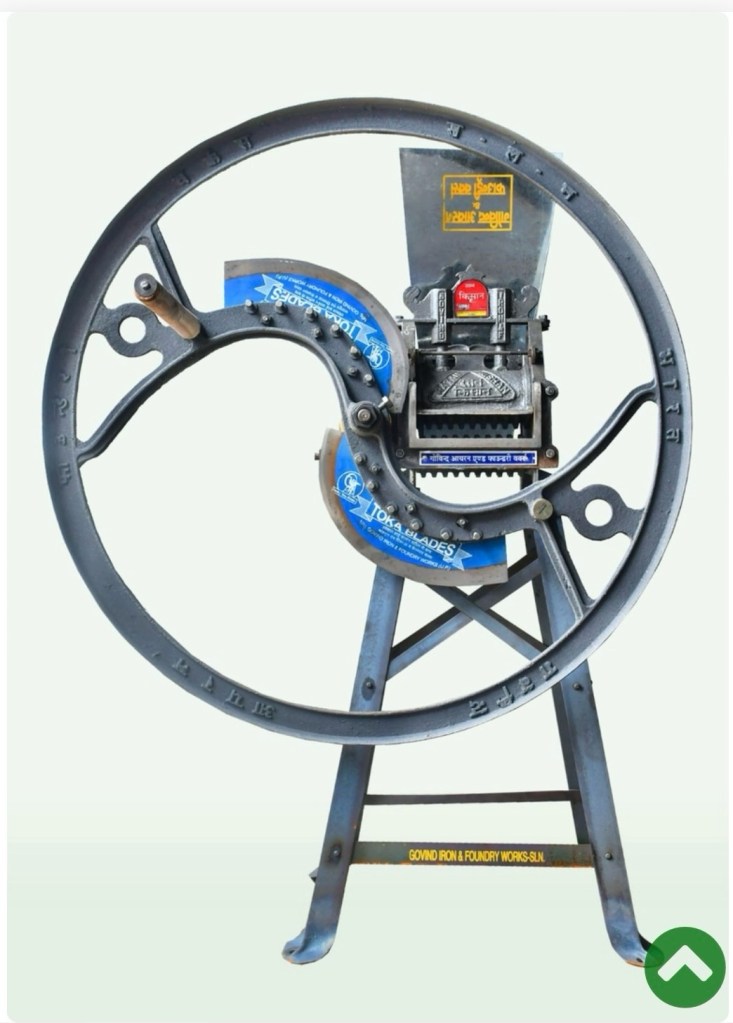
Toka Machine

Reimplanting scalps is difficult due to the multiple blood vessels, but our boss was very good at it. The only person he trusted to assist him was ‘Rattanji’. He knew the specialised instruments and how to assist. A wise person rightly said “To be a good surgeon you need to be a good assistant”. The assistant should know the steps of the surgery and anticipate what instruments or what retraction the surgeon would require. I sometimes equate it to a waltz where the dancing pair know the steps perfectly, when to sway pirouette and bow. But it should not become a Tango!

Rattanji was the perfect partner in the waltz, anticipating the surgeon’s needs perfectly. When the surgeon extended his hand he would know exactly which instrument he wanted without being told. When we had an exceptionally long list in plastic surgery we used to rope in Rattanji to do some of the minor procedures or suturing. He claimed he could do a cleft lip repair surgery and other plastic surgeries.

I am sure everyone in the medical field may have encountered a version of ‘Dr. Jodarams’ and can recount the case of a paramedical staff who was as good as a doctor in a limited field.

The Resident who wouldn’t operate

This satirical essay was written by a former resident describing his journey through surgical residency. He describes his trials and travails with sardonic humour. He prefers to remain anonymous.

Sinbad had done his MBBS from a Medical College in Dakshina Kannada. An average student but often marked out by Professors as someone with ‘great potential.’ It was in internship that he had found his inner calling- Surgery. He loved the smell of spirit and the sight of blood and pus. He was quite eager to dress the burns patients and if ever a resident offered him a lacerated scalp to suture, he would gush about it for the next many weeks. The one time he was told his suturing was better than the residents’, he relived the procedure throughout the night. He enjoyed the company of surgery residents- there was something about them which was different, cool, macho.

The Professors had their quirks but were legendary- to see Dr. Thangam Varghese operating was to see an artist paint, Dr. Sri Ram Bhat’s left hand was spoken of among interns as much as his book was appreciated, Dr.Harish Rao’s diction, Dr. Ashfaque Mohammad’s humor, Dr. BM Nayak’s jogs and intra-op high-fives, Dr.SP Rai’s conduct. He certainly wanted to be a surgeon.

It isn’t clear where he spent the next two years. But he was preparing for the post graduate entrances. His seniors had advised him not to take up any clinical jobs, for they had understood that it was difficult to work and study for NEET simultaneously. As he wrote his first set of examinations he realised a cruel fact. They do not ask you what you should know in entrance exams. It is merely an exam of elimination to aid the filling up of post graduate seats. And so he wrote-ten, twenty, thirty, forty exams and more, across India, in two years and failed in almost all of them, qualified a few but was knocked out at the interview stage in a couple of others. Two years of loneliness, failure, rejection, helplessness and the lack of an identity.

This was when the heavens woke up to his pleas and he found himself a seat in Surgery, somewhere in North India. The years of misery were over. The Promised Land, the land of milk and honey awaited him. And unlike many others, who wanted Orthopaedics or Medicine or Radiology but were settling for Surgery owing to their ranks, he had actually found himself in the field he loved the most. This was going to be tiring but rewarding, or so he thought.

This was what he learnt in Residency.

First Year:

  1. Humiliation is a way of life here. Most things you are shouted at for aren’t even your fault. Shouting at you portrays the Boss as a sinless God in front of the patient. Your senior can scream at you in public for his own fault and you shall put your head down and listen.
  2. It’s all Divide and Rule brother. All the powers that be need do is make your passing conditional to their approval.That is enough for colleagues to find every opportunity to put another down through three years.
  3. Do not trust your own brother if he is your colleague or senior. Nobody is here to learn Surgery the way you thought they would be. In an environment of insecurity, do not expect anybody to keep your secrets.
  4. They will be polite to their wives and children for they need to be. They will be polite to their patients, for they are their livelihood. They will never be polite to you. You are the scum of the earth.
  5. They will say do not eat till the job is done, but make sure you eat. Especially breakfast. They will not care whether you slept in days or not, but will disturb your sleep at midnight by taking an additional round, merely to feel senior.
  6. Hydrocele is your cutting. Unless the Boss decides he wants to teach a beautiful intern what a tunica vaginalis looks like. And this will happen often. If your eyes brighten up at the sight of a hydrocele, teach them not to. Don’t blame the intern, put her to good use. If she can chat up the Boss in OPD, that will save you from a lot of pedal lactic acidosis.
  7. Touch feet as often as possible. Even if your back hurts. You touch feet for years and then you get your feet touched for years. It means nothing. Just keep touching. Makes life easier.
  8. If a wound gapes, it’s your fault. Seroma, Haematoma, Surgical site infection. All of it your fault. Even if you were not present inside the operation theatre and did all you could to prevent it.
  9. Take time out to cry. You need to keep your system light. You might struggle from suicidal ideation, but it is documented that 30% surgery residents do too. So you are not alone. You can always jump off the hostel building like many before you have, but that won’t change the way things work around here.
  10. Don’t work hard. Give an impression that you are hard-working. Both are two different things. Work where you can be noticed, when there is maximum possibility of being noticed. Exert yourself completely to the patient who is Boss’ relative/ mechanic/ driver. Your elaborate burn dressings will never be seen, don’t even bother.
  11. Curiosity and Spirit of Enquiry is all bovine faeces(bull). Never ask questions. Be a YES man. It’s good for your health.

Second Year:

  1. Get a car. Boss has his income. But Boss likes to save. Drive him around. Feed him till he chokes. Your father’s hard earned currency notes are actually confetti meant to be showered on Boss.
  2. If he asks you to buy him a brownie, get him ice cream too. If he asks you to buy him a helicopter, buy him a space station. Why? He knows many ways by which he can ruin your life. He is Boss. The medical establishments have no way of assessing and admonishing the dinosaurs in the food chain.
  3. Your senior is exam-going. He needs a good impression. Take the blame for his mistakes in the morning. You can always whip the juniors in the evening. Or tear up their files.
  4. Hernia is your cutting. Unless the Boss decides he needs to teach an undergraduate damsel how a tension-free mesh repair is done. Or, the Lecturer would be in a mood to finish three hernioplasties under 45 minutes by himself, some silly personal record of his . You will be second assistant forever, or so it will feel. Don’t run throughout the night trying to get the patients fit for surgery. You will get peanuts at the end of it.
  5. Lecturers don’t care about you more than they care about their job. And for many reasons they need to be in Boss’ good books. Else he’ll load them with more cumbersome work and stall their promotions. So anything you tell them in good faith shall be duly reported. And if they tell you something personal, they are merely venting. Don’t read too much into it.
  6. Humour in Surgery sucks. It is almost always slapstick. Almost always centred around boobs and balls. Few get sarcasm and almost no one will understand a pun. The older they get, the more funny they try to be, the worse the humour that comes out. Laugh anyway. Else you stand out as a sore thumb.
  7. Start holding the Boss’ suitcase as he walks in and walks out. Go up to the car. It is all a colonial hangover. It makes absolutely no sense, but do it anyway.
  8. Anaesthetists are almost always women. They almost always are in a rush the moment the scalpel or needle-holder is thrust in your hands. She will insinuate your lecturer or boss about how fast things would have gone had he been operating. Your superior is hormonal. He takes her comment as instruction. Walk over to the other side buddy, again.
  9. They’ll say how their residency was far busier, far superior and far fetched things like how they did Whipple’s alone in a dark room under local anaesthesia. You’ll wonder why they don’t teach you how to drape, hold a needle-holder, place a suture. Never vocalise it.
  10. Flatter. Suck up. You’ve never done it? Well, now’s your time. Flattery always works. Remember, your goal is peace of mind. Nothing else.

Third Year:

  1. Do not ask for surgeries. Ever. Somebody in the food-chain above you will wait till you make the smallest of blunders, and then announce it to the whole wide world. This, despite you going out of the way to hide their own errors from them, and others, for 2 years now.
  2. If you are complimented for your work, deflect it to someone senior to you present nearby. Some patients will want to tell the world how much you have helped them, make sure they do not reach Boss’ ears. He sees you as competition, not as a disciple.
  3. Almost all surgeries in the operative list are supposed to be your cutting. Don’t believe it? Check your logbook. But of course, now that you do not know how to do a hernia well, how can they trust you with a mastectomy or a thyroidectomy. You should have worked harder in your residency. For now, you get nothing.
  4. Buy costly stuff for Boss and his wife. Give it to him as a Diwali present. He will refuse. But that is a token refusal. He is an abyss. Coax him till he takes it home. You need your thesis signed.
  5. Stop entering the O.T. Boss doesn’t think you need to learn surgery nor does he think you need time to study. He will remember to make you write his wife’s research article days before your university exam. Stay out of his sight, stay out of his mind.
  6. It’s a tree of monkeys. Your senior will see only monkeys below him. Your junior will see only Hilton-lined holes above him. The cycle continues.
  7. They’ll tell you observation is learning. It is, but it is not. You can observe a hundred perforation closures but still think of it as an insurmountable mountain. It is only when the scalpel and bovie are in your hand do you learn the trade, which you probably won’t till you are here.

Sinbad received a call from his Boss weeks before his University exam that he was going to be failed. Thanks to the insistence of two Senior Examiners who voted against the pre-meditated verdict, he was passed, in his first attempt. The God who saved Peter from drowning had saved him too. He has come to appreciate the few friends that stood by him in residency, the love of his life was a God-sent balm, his parents helped him stay sane with their regular visits and daily prayers. Now he works in the suburbs under a kind mentor- learning to drape, suture, operate. He insists that not all residents are selfish, lazy and lacking in passion. Some lose their passion in residency.